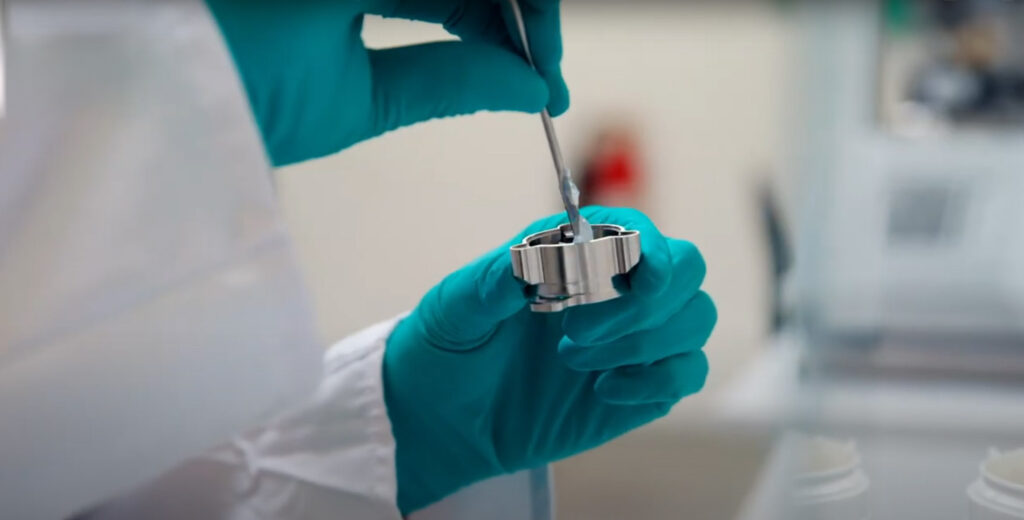
At the KSS trade fair in Stuttgart, Rhenus Lub unveiled its innovative cooling lubricant rhenus FU 800, a fluid that is free from amines, boric acid and formaldehyde deposits. According to the manufacturer, the new product meets the highest health and safety standards and is also not subject to labelling requirements.
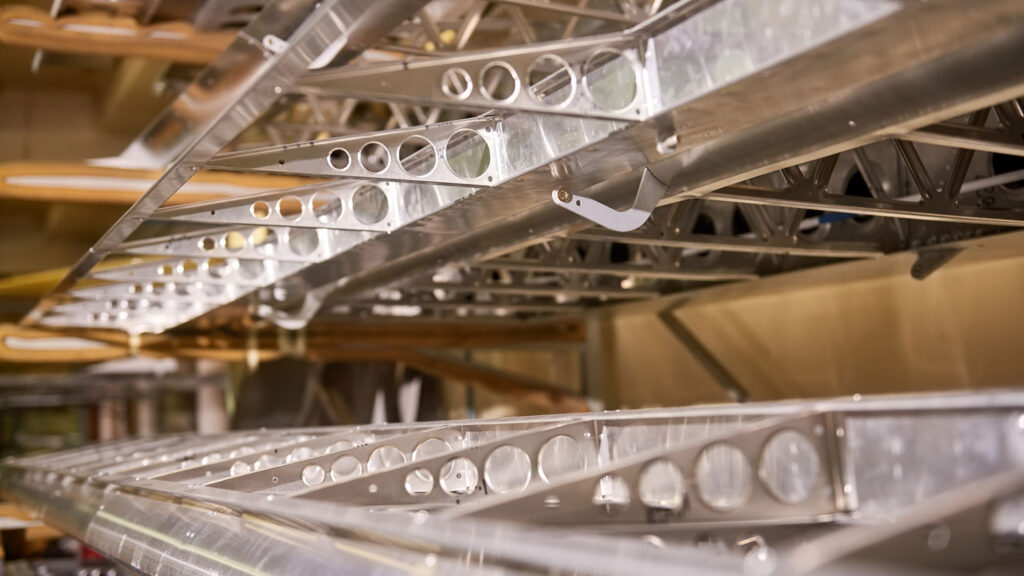
Rhenus Lub undertook an interesting test at Starrag AG in Mönchengladbach. Rhenus Lub had presented the new coolant there without explicitly mentioning its special composition. The customer was therefore initially focused solely on performance. Michael Bleckmann, Head of Manufacturing at the Starrag Group and thus the person with overall responsibility for machining processes within the Starrag Group, was delighted with the results: „rhenus FU 800 clearly met all performance requirements. We observed very good flushing capacity and good foam behaviour. The change intervals were impressive.“ Many users still believe that a high-performance coolant absolutely requires the addition of amines and boric acids. According to the manufacturer, rhenus FU 800 impressively disproves this preconception. In numerous practical tests, the innovative coolant has demonstrated that it is at least as effective as fluids containing amines and boric acid. Furthermore, the tests have shown that rhenus FU 800 can be used universally in demanding machining applications, for example in the aerospace industry, where numerous workpieces have to be milled from solid material – ranging from grey cast iron to aluminium and titanium. Tests were carried out at 14 customer sites on 18 machines and systems, and the new cooling lubricant has not yet reached its performance limits. In developing the innovative formulation of rhenus FU 800, the manufacturer of Rhenus Lub has followed a simple principle: the best approach is to avoid potential sources of risk.
To be on the safe side
Scientists and manufacturers have long been at odds over ingredients and limit values. What is considered safe today may well be classified as a health risk tomorrow. Users are therefore on the safe side if they avoid, as a matter of principle, ingredients that already pose a risk of being banned at some point in the future. After all, anything not contained in the fluids cannot cause skin irritation or any other harm in the first place. Whilst the responsibility for protecting employees always lies with the employer, Rhenus Lub believes that this responsibility begins as early as the manufacturing stage of cooling lubricants. „We view modern occupational health and safety as a preventive measure that we offer our customers – the users in the metalworking industry,“ says Dr Hans-Jürgen Schlindwein, Head of Research & Development for cooling lubricants at Rhenus Lub. Compliance with health and safety guidelines and environmental protection is therefore firmly embedded within the company and ensured through quality management and occupational health and safety management systems such as ISO 9001, 14001 and OHSAS 18001. „We also formulate our cooling lubricants in accordance with these requirements,“ confirms Dr Schlindwein. „When formulating rhenus FU 800, we consistently avoided all ingredients that are currently the subject of heated debate. This makes our new fluid the prime example of a modern cooling lubricant that combines all the positive characteristics – safe, high-performance, label-free and thus fit for the future of machining.“
New emulsifier system inhibits foam formation
According to the Mönchengladbach-based lubricant specialist, the researchers took a new approach when formulating rhenus FU 800. They have consistently avoided the use of additives containing amines and boric acid, as well as a formaldehyde reservoir. In addition, a new emulsifier system was developed specifically for rhenus FU 800, which produces less foam and exhibits good backflushing properties. Why no ingredients containing amines or boric acid? Dr Hans Jürgen Schlindwein explains: „The strictly amine-free formulation of the cooling lubricants prevents the dreaded formation of nitrosamines. Furthermore, the formation of this carcinogenic compound from impurities that may be present in amines is also impossible due to the absence of amines.“ Furthermore, boric acid is also avoided. This is because, under the latest European Union legislation, boric acid is suspected of being toxic to reproduction and thus harmful to human genetic material. Added to this is the absence of a formaldehyde reservoir. The use of formaldehyde reservoirs in cooling lubricants prevents bacterial contamination. As formaldehyde – the basic component of formaldehyde reservoirs – is classified as a Group 1B carcinogen, there is a risk that formaldehyde reservoirs will also be classified as such. „But it can be done without them,“ emphasises Dr Hans Jürgen Schlindwein. „Regardless of legal requirements and regulations, we have found a way to substitute these substances with novel formulations or ingredients. And we have done so without raising the pH value.“ As a result, rhenus FU 800 is exempt from labelling requirements. This also brings economic benefits for users in the metalworking industry. Labelling must be carried out and monitored, and requires staff training. In some cases, costly modifications to machinery and plant may be required. „It therefore makes perfect sense for users to work with cooling lubricants that are exempt from labelling requirements – and which operate at pH levels that ensure excellent skin compatibility, particularly in the case of amine-free cooling lubricants,“ says Dr Hans-Jürgen Schlindwein with conviction.
Source: „Future without labelling“ NC Produktion, Issue 06/2015, pp. 62-64